Start with the idea, not a style label
When you begin looking for tattoo inspiration in Kenya, it is easy to feel that you must know the exact name of a style before contacting an artist. You do not. Start with the subject you want, what you want it to communicate, and the kind of image you are drawn to. A style label can help later, but it should not stop you from explaining an idea in ordinary language.
For example, you might want a flower, a name, a family portrait, a symbol, or an image connected to a personal memory. You may know that you prefer a clean and simple look, or that you like a design with more shading and detail. Those are useful starting points even if you do not know the technical terms.
Separate the subject from the visual treatment. The subject is what the tattoo depicts; the style is how it is drawn and finished. Keeping those two decisions separate can help you compare options without getting distracted by labels.
Notice the visual qualities you consistently like
Look at a range of tattoos and pay attention to the features that keep attracting you. Do you prefer a simple outline, bold shapes, delicate-looking details, lettering, shaded images, or compositions that use a lot of open space? Try to describe the qualities rather than only saving the entire image.
You can make a short list of three things you like and one thing you want to avoid. For instance, you might like a clear silhouette, prefer limited detail, and want the design to remain readable from a normal viewing distance. That is more useful than saying only that you want something fashionable.
Your preferences do not have to fit neatly into one category. It is normal to like different visual approaches for different subjects. The important question is which approach best supports this particular idea and the body area you are considering.
Understand style terms without getting trapped by them
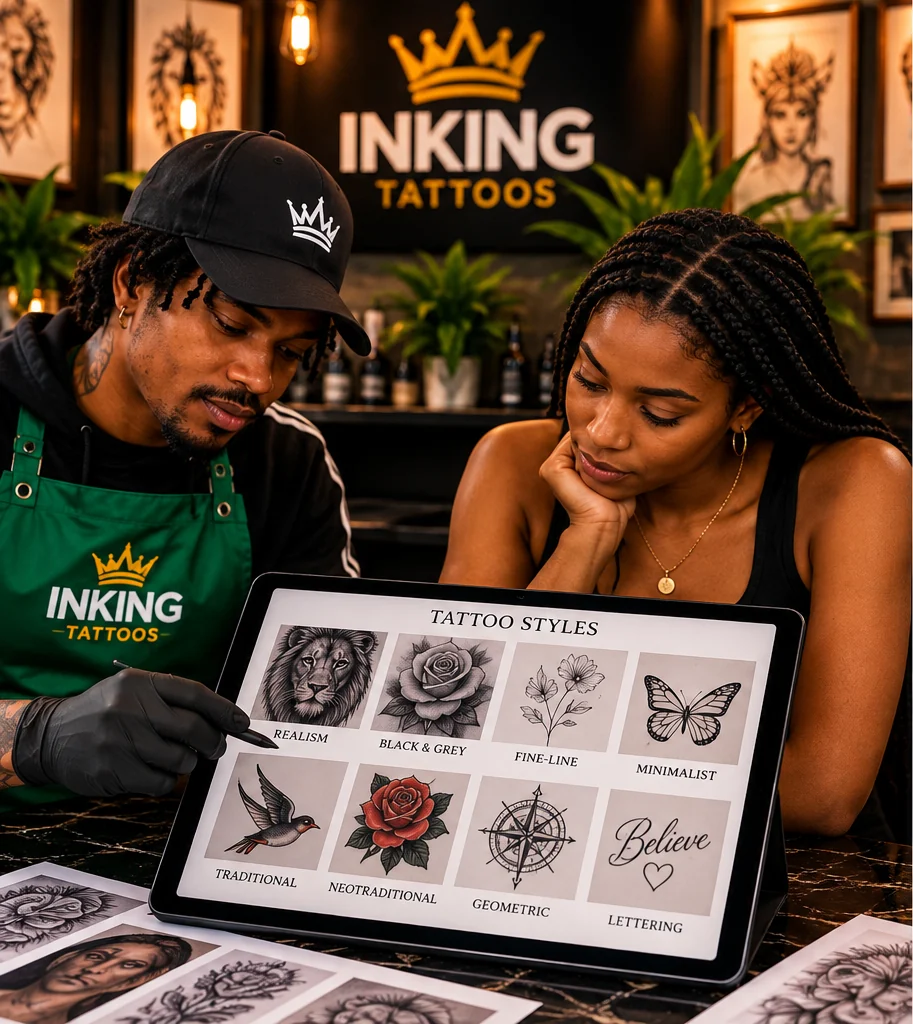
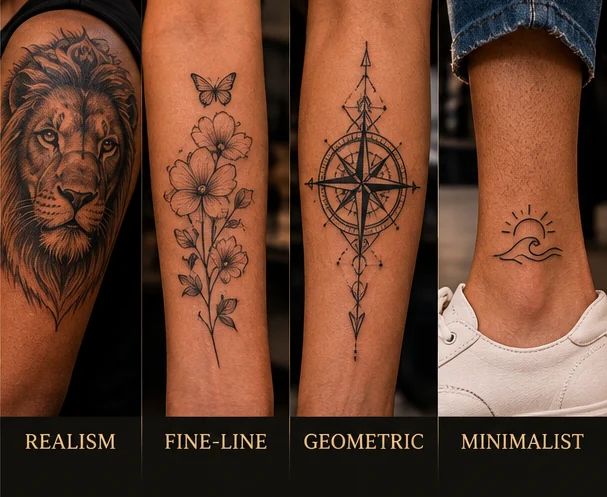
People use tattoo style terms in different ways, and online labels are not always applied consistently. Terms such as black and grey, colour, lettering, geometric, illustrative or fine-line can help describe visible qualities, but a label alone does not guarantee that two designs will look alike.
Instead of assuming a style name tells the whole story, look at the actual work. Notice the line quality, contrast, amount of shading, spacing, level of detail and overall composition. These visible features help explain what you mean when you show an artist a reference.
Do not assume every artist offers every style simply because the style is popular. Review the artist's actual published work and discuss whether your idea is a good fit. If a particular approach is essential to your design, make that clear before making plans.
Build a short style brief before asking for a design
Before contacting an artist, write down the subject, the visual qualities you prefer, the approximate size and the body area you are considering. Add two or three references, with a note beside each explaining what you want to borrow from it, such as the outline, contrast or composition.
Then identify what matters most and what can change. You might want the subject to remain recognizable but be flexible about decorative elements, or you might consider a particular lettering style essential. Making that distinction helps the artist understand where you want input and where you have a firm preference.
Ask the artist to explain any suggested simplification or change in scale before approving the final direction. That conversation can help you understand the trade-offs between the look you like, the space available and the level of detail the tattoo can reasonably support.
Choose a style that supports the subject
The same subject can feel different when its visual treatment changes. A flower might be represented as a simple outline, a more detailed botanical image, or a bold graphic shape. A name might be the central feature of a lettering tattoo, while a portrait idea depends on the source image and the way the face is represented.
Ask what must remain recognizable for the tattoo to work. If the main point is a particular symbol, a clear silhouette may matter more than decorative detail. If you want to remember a person, you may need to think carefully about whether you want a portrait, handwriting, a date, or another image connected to that person.
Avoid adding detail just because it makes a reference look impressive on a screen. Every element should have a purpose and fit the size you are considering. A simpler design can communicate an idea clearly without being less personal.
Develop a meaningful tattoo idea →Turn a personal subject or memory into a clear design brief.
Use references to explain what you mean
References are useful because they show details that can be difficult to describe with words. One image might communicate the subject, another the composition, and a third the amount of shading or visual simplicity you prefer. A small, carefully selected group is usually easier to discuss than a large folder of unrelated screenshots.
Write a short note beside each reference. Explain what you like about it and what you do not want to carry over. You might like the placement but not the design, or the subject but not the lettering. This distinction helps prevent an artist from having to guess which feature matters to you.
Use references as direction rather than assuming another person's finished tattoo should be copied exactly. Your design may need to change to fit your body area, size, preferences and the way the idea can work as a tattoo. If you want something personal, explain the parts that are meaningful to you rather than relying only on an image.
Think about size before choosing fine detail
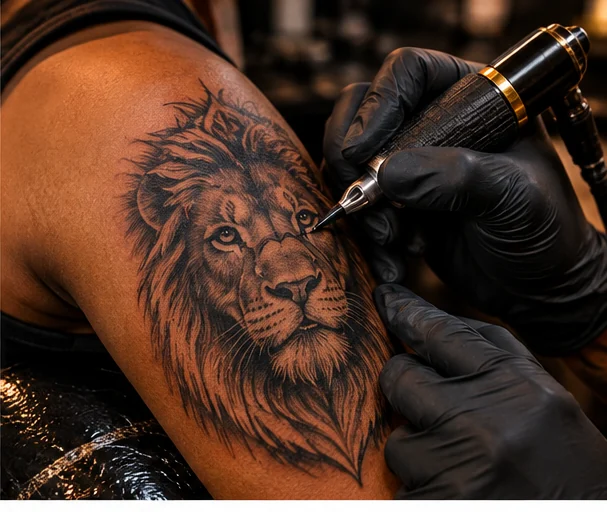
A design that looks clear when enlarged on a phone may contain details that are difficult to retain at a small tattoo size. Lines, gaps, lettering and closely grouped elements all need enough space to remain visually distinct. This is why the intended size should be part of the style conversation from the beginning.
If you want a compact tattoo, identify the essential features and be open to simplifying the rest. If every small detail is important, ask whether a larger size or a different composition would suit the idea better. Do not assume that shrinking a complex reference will preserve everything that makes it work.
A style should be judged in the context of the actual tattoo you plan to get, not only by how attractive the reference looks on a screen. Discuss the size with the artist before treating the design as final.
Small tattoos in Kenya →Explore how size, detail and placement affect a small tattoo.
Let placement inform the design
Placement affects the space available, the shape of the composition, visibility and how the tattoo fits into everyday life. A design that works as a wide image may need a different arrangement on a narrow area. A highly visible placement may also require a different level of thought about work, personal preference and how often you want the tattoo to be seen.
If you already have a body area in mind, tell the artist early. If the subject matters more than the location, explain that too and ask which placements might suit its shape and detail. You do not need to settle every choice alone before asking for guidance.
Consider the practical side as well as appearance. Think about clothing, work routines and whether you may want to add other tattoos nearby in the future. The right style is not only the one you like in a photograph; it should also work with the placement you choose.
Read the placement guide for Kenya →Compare visibility, design fit, clothing and other placement considerations.
Decide how much contrast and detail you want
Contrast helps separate the parts of a design and affects how easily the image can be read. Some references rely on strong differences between dark and light areas; others use more open space and restrained detail. Think about which visual quality you prefer and whether it supports the subject.
A reference with many small details may be attractive because it is shown close up. Ask whether the same details are essential to the idea or whether the overall subject would still work with a clearer, simpler arrangement. The answer depends on the specific tattoo, so it is worth discussing rather than guessing.
Do not choose a design solely by the filters, lighting or editing used in a reference photograph. Look for several examples of the actual work where possible, and remember that a photograph cannot tell you everything about how a tattoo will look in person or heal.
Lettering and portraits need specific planning
Lettering depends on the exact wording, spelling, spacing and visual form of the letters. If you want a name, date or phrase, verify every character before the design is finalized. If the wording is in a language you do not know well, check it with a reliable source or knowledgeable speaker instead of trusting a decorative image or automatic translation.
Portraits require careful thought about the source photograph, expression, composition and intended size. Decide whether you want a literal portrait or a design inspired by the person, such as handwriting, a meaningful object or another personal symbol. Those are different approaches and may lead to different design conversations.
Jay works across tattooing, drawing, portrait art and commissioned art. You can explain a portrait-related or drawing-based idea as part of the conversation, but use the published portfolio to assess the tattoo work relevant to the style you want.
Do not choose a style only because it is trending
Social media can help you discover possibilities, but popularity is not the same as personal fit. Ask yourself whether you would still want the tattoo if you stopped seeing that design in your feed. If you are unsure, save the reference and return to it later rather than rushing the decision.
This does not mean avoiding popular subjects or styles. It means checking that you like the design itself and understand what you want from it. You can choose a familiar symbol and still make thoughtful decisions about composition, size, placement and the details that matter to you.
A permanent tattoo deserves a decision based on your preferences rather than the pressure to follow a trend. If you find that your idea changes as you explore references, that is useful information to bring into the planning process.
Combine inspiration without copying a finished tattoo
You might like the composition in one image, the subject in another and the amount of shading in a third. Explain those separate preferences instead of asking for one person's finished tattoo to be reproduced exactly. That gives the design discussion a clearer starting point.
Be specific about what should stay and what can change. Perhaps the subject is important, while the orientation, decorative elements or background are flexible. A short explanation of those priorities can help an artist understand your idea without treating every detail in the reference as mandatory.
Combining inspiration works best when the result is built around your own subject and requirements. If a symbol has a cultural, historical or religious meaning that matters to you, verify the context rather than relying on an unsourced social-media caption.
Use a decision filter before committing to a style
Before settling on a direction, check it against four practical questions: does it communicate the subject you care about, can its important details fit the size you want, does it suit the body area you are considering, and do you still like it when you look beyond a polished reference photo? If one answer is uncertain, treat that as something to discuss rather than a reason to rush.
Then separate must-haves from preferences. For example, the subject or exact wording may be essential, while the background, decorative marks or amount of shading may be flexible. This makes it easier to discuss changes without losing the part of the idea that matters most to you.
If two styles both appeal to you, ask the artist to explain the practical trade-offs for your particular design. Compare the proposed composition, size and detail—not just the style names—and take time to decide before approving the final design.
What affects the cost of a chosen style?
Style can affect the amount of design preparation and tattooing work involved, but a style name does not produce a reliable price by itself. Size, detail, placement and the specific design all matter. A small, detailed piece may involve different work from a simple design of similar dimensions.
Inking Tattoos starts from KSh 1,000. That is a starting price, not a promise that every tattoo or every style costs KSh 1,000. Share the idea, references, approximate size and placement with Jay so the specific work can be discussed.
If your budget is limited, say so early. You can discuss whether simplifying the composition, changing the size or adjusting the design would preserve the most important parts of the idea. Do not assume every detail can remain unchanged at any budget.
Understand tattoo prices in Kenya →Learn what affects a quote and what the KSh 1,000 starting price means.
Discuss your idea with Jay in Limuru
Jay is the main tattoo artist at Inking Tattoos in Limuru Town, Kenya. When you contact him, send the subject, a few useful references, approximate size and preferred placement. Explain what you like about the references and what you want to change.
You do not need to know the correct style name before starting the conversation. A clear description of your preferences is a useful starting point, and you can say which decisions are still open.
If you want to discuss a mobile tattoo session, include your location. Mobile availability depends on the location and arrangement, so do not assume that travel is available everywhere in Kenya.
Discuss your tattoo idea with Jay →Contact Inking Tattoos with your references, approximate size and placement.
Frequently asked questions
Do I need to know the style name before contacting an artist? No. Describe the look you like and share a few references that show it.
How many reference images should I send? There is no fixed number. A small group with notes about what you like is usually more useful than many unrelated images.
Can one tattoo combine different influences? You can discuss different influences, but explain which qualities you want from each reference and allow the design to be adapted to your idea.
Should I choose the style before the placement? Consider them together. Size and body area can affect how the design needs to be composed.
Can a detailed style work for a small tattoo? It depends on the actual design. Discuss whether the important details will remain clear at the intended size.
How much does a tattoo cost in Kenya? The price depends on the design and work involved. Inking Tattoos starts from KSh 1,000, but that is not the price of every tattoo.
Can I discuss a mobile session? Yes. Include your location when contacting Jay, because mobile availability depends on location and arrangement.